
Your Event Has One LinkedIn Page. Your Attendees Have Hundreds Of Networks.
Most event organisers treat photography as a wrap-up task. Photos are uploaded, a recap post goes live, a folder is sent, and the team moves on. But the most valuable role of event photography is not documentation. It is distribution.
Every strong photo of an attendee, speaker, sponsor, exhibitor, or team member can become a reason for that person to tell their own professional network: I was there. I met these people. I learned something useful. My company participated. This event was worth paying attention to.
Your event's LinkedIn Page has one audience. The people who attend your event collectively have hundreds—or thousands—of relevant professional networks. The opportunity is not to make them post scripted promotional copy. It is to make it easy for them to share a real moment from an event they were genuinely part of.
People Share People

The best event content is rarely an empty venue photo, a stage backdrop, or a generic brand graphic. It is people.
A study of business-event attendees found that
The same study found that attendees were most likely to take social actions—such as liking, sharing, or commenting—when fellow attendees were the focus of the content.
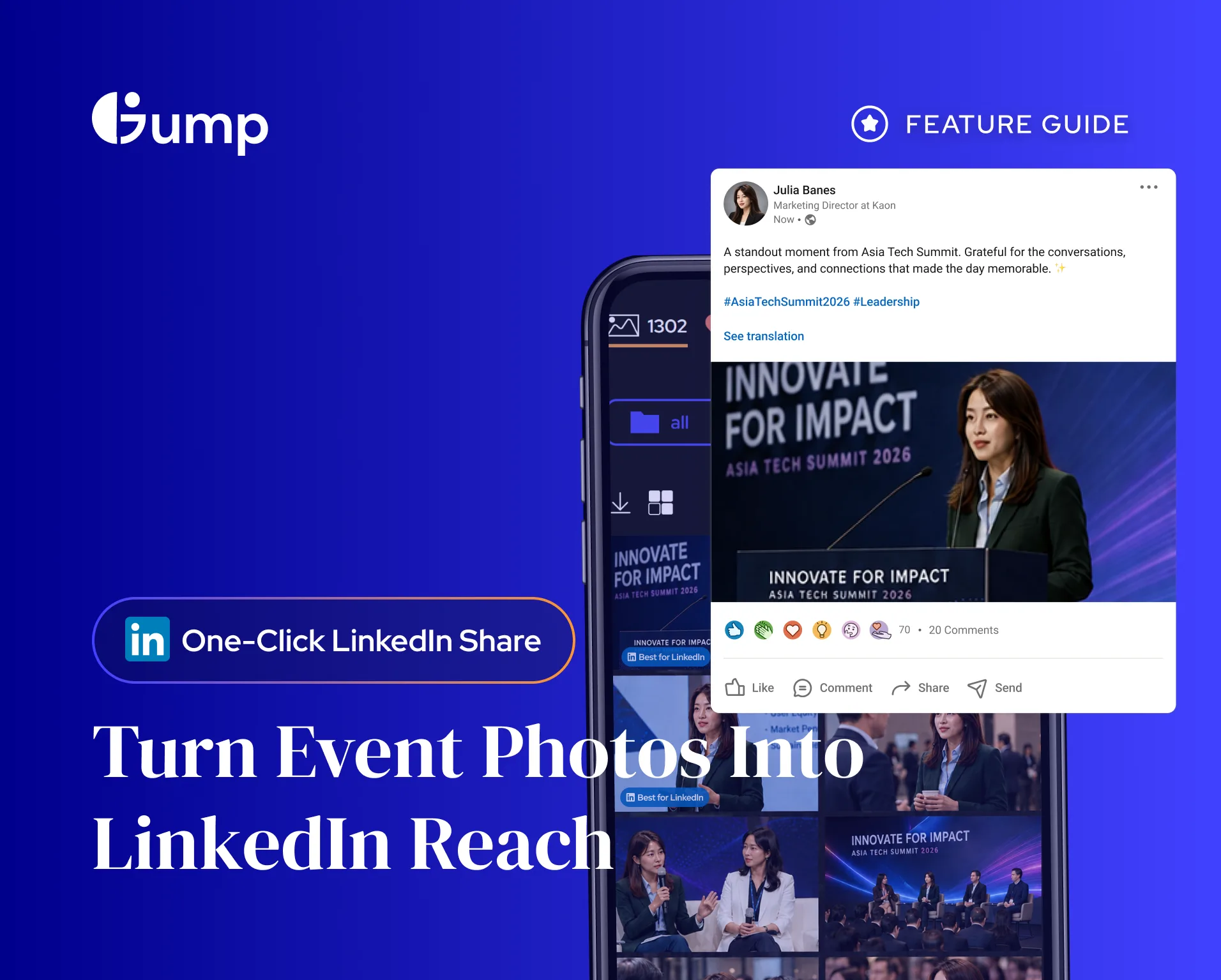
That is the strategic opportunity behind Gump’s LinkedIn Share feature. Instead of asking attendees to search through a large photo folder and decide whether a post is worth the effort, Gump helps them find the moments that are personally relevant to them.
The Event Marketing Problem Is Friction
Most people do not avoid sharing because they disliked the event. They avoid sharing because the process is inconvenient: finding the right image, downloading it, deciding if it looks good enough, writing something professional, locating the event hashtag, tagging the organiser, and posting before the event feels old.
Gump changes the workflow from “Here is a folder” to “Here is your moment, ready to share.”
From Event Photo To LinkedIn Post

• Enter the gallery: An attendee scans a QR code or opens the event gallery.
• Find the moment: AI-assisted photo discovery helps the attendee locate their own event photos.
• Choose the image: Gump can surface a strong photo suitable for LinkedIn.
• Prepare the post: Suggested copy, event hashtags, and organiser mentions reduce writing friction.
• Share: The attendee personalises, previews, and shares a LinkedIn-ready post.
The organiser sets up the event experience once. Attendees, speakers, sponsors, exhibitors, and employees can then find and share their own moments at scale.
Why This Matters To Event Organisers
Create earned distribution beyond your own followers
Participant posts reach different networks: colleagues, customers, partners, peers, future attendees, and
decision-makers who may never follow the organiser directly. Each attendee post is a new point of distribution; each speaker, sponsor, or exhibitor post extends event visibility into a different professional network.
Build social proof for the next event
Participant posts show who attended, what conversations happened, whether people were learning and connecting, and whether the audience was relevant. This is useful material for future registration, sponsor sales, speaker recruitment, and community growth.
Give sponsors and partners additional visibility
When attendees, speakers, and exhibitors tag an event or sponsor in authentic posts, the organiser gains participant-led content, mentions, engagement, and visibility that can strengthen sponsor reporting.
Make post-event marketing measurable
LinkedIn provides post-level analytics including impressions, members reached, in-network and out-of-network discovery, profile viewers, followers gained, reactions, comments, reposts, saves, sends, and external-link visits. [web:66]
What To Measure
Outcome | Metrics to track | Why it matters |
Photo discovery | Gallery visits; selfie-search completions; matched-photo views | Shows whether people can find personally relevant content |
Content value | Photos selected; saved; downloaded | Shows whether the photo experience is useful |
Sharing intent | LinkedIn share clicks; caption copies; post-preview opens | Shows movement from photo discovery to promotion |
Participant distribution | Event hashtag posts; organiser mentions; sponsor tags; exhibitor posts | Shows how participants extend event visibility |
Reach | Impressions; members reached; out-of-network reach; reposts; sends | Shows how far participant content travels |
Engagement | Reactions; comments; saves; profile visits | Shows whether content creates interest and conversation |
Demand | UTM site visits; newsletter sign-ups; waitlist joins; event enquiries | Shows whether shared content creates owned-channel demand |
Commercial value | Sponsor mentions; partner-post volume; next-event registrations influenced | Helps connect distribution to business outcomes |
Start With A Baseline
Gump should not claim that every LinkedIn post creates a sale or registration. The first event should establish a baseline: how many people opened the gallery, found their photos, selected an image, began a share flow, and mentioned the event. Then organisers can compare reach, engagement, traffic, and future-event demand across editions.
A Simple Planning Example
Imagine a 1,000-person conference. If 10% of attendees share one LinkedIn-ready event post, that creates 100 participant-led pieces of event content—before counting speakers, sponsors, exhibitors, organisers, and internal team members. This is a planning illustration, not a promise of reach or conversion.
Make The Event Easier To Talk About
The best event marketing continues in the conversations attendees have with colleagues, customers, partners, and peers. Event photos are often the simplest way to start those conversations—but only if participants can find and use them without friction.
Gump turns event photography into a measurable LinkedIn distribution channel: find your photo, share your story, and help the event stay visible after it ends.